Thursday, March 12, 2015

Roosevelt Favorites: Without Blemish by John Talley III


In my private reading time, I’m currently in the book of Leviticus. I know some of you may wonder, “Did he just say Leviticus?” Yes, I said Leviticus! It’s actually a really good book. I strongly encourage you to pick it up. You will encounter the holiness of God and how He reveals and regulates the people of Israel.

Holiness is the clear theme in this book, which is part of God’s character and what He desires.

The great theologian, R.C. Sproul, writes, “I am convinced that it [holiness] is one of the most important ideas that a Christian can ever grapple with. It is basic to our whole understanding of God and Christianity” (Sproul, 1998, p.11). Furthermore, this book is full of rich theology, but one thing that stuck out to me was this phrase: “without blemish.” Theologically speaking, something that has a flaw or mark is not worthy, sufficient, nor acceptable as a sacrifice.

Consider these verses, which contain this phrase “without blemish”:

Leviticus 1:3- “If his offering is a burnt offering from the herd, he shall offer a male without blemish.”

Leviticus 1:10- “If his gift for a burnt offering is from the flock, from the sheep or goats, he shall bring a male without blemish.”

Leviticus 3:1- “If his offering is a sacrifice of peace offering, if he offers an animal from the herd, male or female, he shall offer it without blemish before the Lord.”

Leviticus 3:6- “If his offering for a sacrifice of peace offering to the Lord is an animal from the flock, male or female, he shall offer it without blemish.”

Leviticus 4:3- If it is the anointed priest who sins, thus bringing guilt on the people, then he shall offer for the sin that he has committed a bull from the herd without blemish to the Lord for a sin offering”

Should I continue? I don’t mean to be beat a dead horse, but I think you guys get the point. Without blemish is a repeated phrase throughout this great book. But what exactly does it mean?

First, we have to understand the context. The people of Israel were commanded to live a certain way because God desires for His people to be Holy (Leviticus 20:26). Mark Dever, the founder of 9Marks and a pastor in D.C., writes, “…[H]e also wants [H]is people to live distinctly from the fallen world around them, where people do not naturally reflect [H]is character. His special people should be distinguished from the nations by the way they live” (Dever, 2006, p. 94-95). In addition, He governed His people in a way that they were to make sacrifices (i.e. burnt, grain, peace, and other offerings).
Second, we must understand that perfection is the standard. God’s holy righteous standard has always been perfection. This is what the phrase without blemish is trying to communicate. All of the animals in the Old Testament that were sacrificed had to be spotless to be considered an offering in the first place. Moses makes this point evident with the previous verses that I mentioned (Leviticus 1:3, 10, 3:1, 6, 4:3).

Last, we must understand that these sacrifices ultimately point to Jesus Christ. These sacrifices symbolized the payment for sinful deeds, but do not fulfill them. Christ does that on behalf of all those who repent and believe in Him. He is the embodiment of what it means to be without blemish. He was born of a virgin, fulfilled the law, suffered, died, and was resurrected. Hebrews 4:15 tell us the He was tempted like we were, yet was without sin. Philippians 2:6 tells us that He was in the form of God. Who better to meet the criteria of perfection?

In conclusion, I love the book of Leviticus. I’m looking forward to continue learning more about His holiness and how God regulated the people of Israel. It is important to understand the context, to know that perfection is the standard, and to see that the sacrifices foreshadow the Lord Jesus Christ. He is the ultimate sacrifice that satisfied the wrath of God. Have you repented and trusted in the risen Savior who is without blemish?

Tuesday, March 10, 2015

Pastor V’s Shout Outs by Vermon Pierre


My list of things I want to highlight. So, shout out to:

1. Lecrae and his last album, Anomaly. It did take me about two or three listens to figure it out, but I eventually came to really like it. I understand it now as more of a complete project (as opposed to a bunch of random singles stuck together), which can be appreciated as a complete story from the first track to the last. Some of my favorites tracks include “Give In” (powerful and convicting for me every single time I hear it) and “Nuthin” (all you old school hip hop heads, did you catch the “I’ve Got 5 On It”  by Luniz sample in this track?)

One review of his album worth checking out is here.

2. Jordan Taylor and his “one free single per month” deal. Staying on the music tip, I’d like to highlight the creative work that our brother Jordan has been doing recently. The music is some of the freshest stuff I’ve ever heard from him (or from most musicians out there); but I have to say I especially enjoy the graphic art and writing that goes along with each single. Keep putting out the good stuff, man!

3. Jen Wilkin’s blog post on the necessity of male-female friendships in the church can be found here. I’ve been told that men and women can’t be friends and now, more than ever, I want to say that this is absolutely ridiculous and potentially harmful to cultivating real community. Let’s remember that the Bible has a category for men and women to interact with each other outside of the marriage relationship, and that is the category of family, of being “brothers and sisters” in Christ. Inherent in the brother-sister relationship should be healthy supportive loving friendships, friendships that obviously can (and should!) stand up against the temptations that tear apart male and female relationships in the secular non-gospel-based world.

Thursday, March 5, 2015

Pop Culture Corner: What Does It All Mean? Sean McGinty and Jennifer Bell Talk Zombies


Jennifer:  I guess this discussion arose from your own mention of an interest in zombies. This got me thinking. In all honesty, up until February 2015, I really never gave them a serious thought. I’ll tell you a little about how my own preoccupation began, and then I’d like to hear from you.

First, I’m very much into the world of writing and the Arts, and what it means for Christians to be both writers/artists and patrons of the Arts. Second, I think TV is undergoing a kind of renaissance, in which the quality has blossomed. There’s something big writer snobs like me talk a lot about: “Literary TV.” This TV Renaissance, so to speak, has totally sucked me in—and I’m no longer dissing TV. Though a lot of it is sooooo very dumb. Third, trends in pop culture fascinate me. What leads to these trends? What do they say about culture? About Christianity? Fourth, I said I’m a snob. I am. I probably shouldn’t say that. Especially in a churchy forum. But, well, my husband and I—having neared the very end of the Great American Novel of Television, “Mad Men”—decided to turn on “The Walking Dead.” Sick fascination? Lurid interest? Zombies are—let’s face it—in. A total cultural phenomenon. So we tried it out.

Sean, let me tell you this: I freakin’ love that show!

Originally, I thought it was dumb (I don’t anymore) and, line-by-line, the writing was weak. Now, I’d suggest that—despite plot holes and unanswered questions—the story is pretty strong. But what’s the deal? Sean, what is your own interest? And should Christians pay attention to this cultural phenomenon?

Sean: Whenever I start thinking about the zombie genre, I end up thinking about a movie that doesn't have a single one: Carriers, the 2009 film starring Chris Pine (the new Capt. Kirk). Quick plot overview: Two brothers and their girlfriends travel across a plague-devastated America in hopes of reaching a childhood vacation spot. The group has adopted a set of rules which need to be strictly followed if they want to stave off infection (ex: Don't try to help the sick because they're already dead). The course of the trip tests how dedicated the foursome truly is to those rules and how they react when they're on the wrong side of them. 

“Rotten Tomatoes” clearly disagrees with me on this, but I think it's a great movie. And relevant to our discussion. It's one that reflects most of the elements that are so attractive in the zombie genre . First on that list, Independence: and not necessarily the good kind. Zombies are the quintessential American monster. I mean, it's a hoard of people that sweep clean the existing government and society, allowing the survivors to set up their own vision of order. That's American Soul 101. The first scene of Carriers has the kids in a stolen Benz, driving through a Western landscape, drinking beer and acting like it’s spring break. It's the picture of freedom from authority, and we love it. It's the same reason John Wayne was a star, striking out to places where he could make his own law and play the game however he liked. Looking at “The Walking Dead,” we see it when Glenn hops in that red sports car and peels out of Atlanta on the wrong side of the road. Nobody tells us what to do.

Jennifer: First, I just added Carriers to my Netflix queue. Second, be very careful what you say about “The Walking Dead.” No spoilers allowed!

Sean: No spoilers, promise. So theme # 1 is Independence. Theme #2 is the presence of Moral Dilemma. The zombie genre is able to engage viewers by pushing the moral stakes to the maximum. It let's us fiddle around with the question of what we would do in similar circumstances. It's a powerful hook although, more often than not, zombie movies bungle it. They tend to contrast merely flawed protagonists with ΓΌber-wicked bad guys. Since we naturally identify with the hero, I think it causes us to belittle our own fallenness. We like to think of ourselves as Rick Grimes instead of the blatantly evil Governor. Yeah, we're a little messed up; we make mistakes, but deep down we're pretty okay. We do terrible stuff sometimes, but it's justified. Carriers never gives us that option. Without revealing too much, the characters’ attempt to set up their own independence via the rules for survival proves disastrous. These aren't people who help us affirm the basic goodness of humanity. In fact, the character we most identify with, the one who seems the most moral throughout the movie, is the one who commits what is arguably the worst crime of all. And the film doesn't go on to excuse it. It just leaves you with the question of how much are you willing to lose in order to do the right thing.

Jennifer: I can’t wait to see this freakin’ film. (Good point, though, on this basic goodness issue. Much of the artistic offerings we see do not deal with the fallen nature of humankind. We are all Rick Grimes, a pretty good guy.)

Sean:  I think you'll like Carriers. But, finally, the zombie genre is popular simply because it's violent. Theme #3 is Violence.  I had a professor in college who occasionally made shows for the History Channel. He bemoaned the fact that the network required images of sex or violence at least every two minutes in order to keep the viewers attention. “The Walking Dead” is particularly egregious on this count. The producers have routinely giggled like sixth graders about how they're allowed to make the show as bloody as they like. And, ultimately, this is one of the things that holds the show back. “The Walking Dead” is consistently able to ride the wave of shock value instead of working on its many weaknesses.

Jennifer: You know, I’m not totally sure I agree with you on the appeal of violence, but I would need to think more about it. I don’t think I’m into the violence and gore. I think I like the other two things you mentioned, though, and the idea of exploring how the future is constructed by secular society: that interests me a lot. But I need to think more about it.

Without spoilers, what would you say are its weaknesses? If you can’t say without revealing plot stuff, don’t say it.

Sean: I think the main problem is, as you pointed out, the weak writing. You're somewhere in Season 2, right? By the second half of Season 4, it's like they realized that dialogue isn't their forte and just decided to eliminate as much as possible.

Jennifer: I’m sorry to hear that.

Sean: Pacing is also a major issue. By their very nature, zombie stories usually turn into either road trips or sieges. That doesn't give you a ton to work with, and I suspect that's why we get whole episodes of characters going on supply runs . . . and not completing them before the credits roll. That wouldn't be a huge problem if the characters were fleshed out well, but the majority of them have always seemed two-dimensional. And, again, the extreme violence acts as camouflage for all this.

Jennifer: I just want to quickly interrupt you to mention that the road trip element, while not at all unique to Americans, definitely has a special appeal. So, with this zombie apocalypse, we’ve got this admixture of elements like the cowboy/anarchist/renegade, the road trip, and future anxiety. But back to you . . .

Sean: Carriers is a strong contrast here. It doesn't get bogged down with voyeuristic violence. The movie draws its tension from moral choices and relationships, which creates a more lasting impression than the numbing gore of “The Walking Dead.” 

As to whether or not it's important for Christians to be paying attention to the current monster zeitgeist, I'd say no. TV and movies can be fun to watch and discuss, but I don't think they offer much value to the Christian life other than that. I'm of the opinion that Christians are way too concerned with pop culture trends. It seems as though this stems either from the belief that the Gospel isn't interesting enough on its own and needs to be hidden in whatever is popular at the moment, or from the desire to not be seen as all that different from our non-Christian neighbors. These positions, if maintained, will inevitably lead to a watering down of God's Word, a hyper-spiritualization of trivial things, and the dangerous pride of wanting to be thought well of by the world. So sure, relax with a movie or a little TV, but I don't think we should consider it more important than that.

Jennifer:  Oh, no, Sean! I hope you’re up for this. I’m about to totally, unequivocally disagree with you!

Sean: No problem, I like a good back and forth.

Jennifer: Well, first, some kindly affirmation of your thought process! I like what you’re saying about zombies as the quintessential American monster, though—and this is probably important—they have Haitian roots, as well as other important non-American sources. Perhaps what is even more significant than the monster is the response. The response to zombies may be the quintessential American response: Zombies turn us all into cowboys, and cowboys are American.

Sean: I think the Haitian origin of zombies fits nicely into their categorization as American. They're immigrants! And they change pretty dramatically once they land here. The Haitian zombie was sort of like an undead robot controlled by a voodoo wizard. The modern "destroy-the-brain!" hoard didn't show up until Romero's Night of the Living Dead. And yes, I do hate myself a little bit for knowing this much about zombies.

Jennifer: Still, though, why zombies? Doesn’t some other kind of apocalypse evoke the same response? What is so especially important about the Zombie Apocalypse? Why the masses of brainless dead people?

Sean: I'm not sure the zombie apocalypse is really all that different from the wider dystopian genre. Many of the elements that are common in zombie movies are found in series like The Hunger Games or Divergent. I imagine part of the popularity is due to the violence, but I also think it's just a matter of fashion. A decade ago vampires were everywhere; now it's zombies. In another ten years, it'll be Bigfoots or something. Try to turn that one into a supernatural romance, Hollywood!

Jennifer: I’m a little all over the place here, so bear with me—but one of my first responses to “The Walking Dead,” when we began watching and I was all skeptical, was that the brainlessness took something away for me. What? A challenge? They’re dumb! Why is that the face of the apocalypse?

And this is why I’m ultimately disagreeing with you. I think pop culture and TV reflects the heart of the audience, and those interested in zombies are, through their interest, expressing spiritual preoccupations. I have definitely thought about this in terms of the preponderance of apocalyptic films (ranging from I am Legend to The Book of Eli, to barely skim the surface). There are reasons for this preoccupation. They reflect spiritual anxieties, desires, hopes. Where is meaning found in the apocalypse? Why is the apocalypse always so lousy, so fearful? The future is inevitably scary and hopeless. What makes one a hero in the apocalypse?

And, once one has accepted this preoccupation with the end times, we might turn to a secondary question. Why zombies, our favorite apocalyptic creation?

So, let me turn it over to you with this challenge: there’s no such thing as watching TV for the mere purpose of entertainment. We’re selling ourselves short. We need to take every thought captive. Even zombies. Especially zombies. TV as mere entertainment is—dare I say it—distasteful to me.

Sean:  I wouldn't necessarily disagree with the notion that popular TV and film reflect spiritual characteristics of the viewers and creators, but a lot of things do that. Your conversations with your coworkers, the way you spend your money, how you act in a traffic jam: they all reflect the heart to some degree. So my push-back question is what makes TV so special? 

Or, look at it this way, do Christians need TV and movies to grow spiritually? Did Christians prior to the 20th century have a more difficult time increasing in faithfulness? Clearly not, nor would many of those past Christians point to the pop culture elements of their own time as being particularly important.

The only thing that really lays open the heart is God's Word. Scripture describes itself as a sharp sword able to pierce the intentions of a person. The Spirit works through the Word to reveal our sinfulness and the redemption of that sinfulness on the Cross. These are the things that draw us closer to the Lord and subsequently allow us to love people better. Television and movies can't do that, and so I'm hard pressed to think of them as having much importance for the Christian life.

Now, I can appreciate the argument that TV could help us get a bead on cultural issues, which can potentially be useful in communicating the Gospel to non-Christians. Yet, even here, I wouldn't put too much emphasis on it. While every time and place has its own particulars, the humanity of The Aeneid is the same humanity of “The Walking Dead.” That is to say, pop culture isn't really telling us anything we didn't already know. The longing for redemption, for example, is always there. It expresses itself in different ways, but it's not as if Daryl's growth as a character suddenly opens our eyes to its reality.

Jennifer: Them’s fightin’ words, Sean! I won’t go crazy on you, though—and we can’t go on and on about this exhaustively, though it’s tempting. I’m stung by your suggestion that pop culture isn’t really telling us anything we didn't already know. For me, this raises many, many important questions: Is TV “art”? Is it a “low-brow” form of art? Is pop culture also “low-brow”? Is Art or TV or pop culture merely reflective, as opposed to being its own constructive or creative force? And, finally, is Daryl’s growth as a character opening my eyes in any way?

Very briefly, I do want to say this. I really think—and I’ve thought about this way too much—that TV is an art form, and it’s also undergoing a fairly spectacular renaissance, as I mentioned earlier, as it moves closer and closer to the novel. Recent years have revealed something along the lines of literary TV with serialization, which you find in such shows as “The Walking Dead” or “Mad Men.” Unlike the classic daytime soap opera, these new shows worry over big, complex themes—the stuff of Art with a capital A. There’s still a lot of garbage, of course, and “The Walking Dead” is no Sistine Chapel—but the potential for TV is there.

And, in saying this, I would strongly, adamantly, wildly, and ruthlessly argue that Art and pop culture are not merely reflective. In these things, one may see how reality is understood, indeed. But, in these things, one may also see reality better and more clearly than one ever has before. Art and pop culture can offer visions of reality that make sense to us, that help us to comprehend our world, that enlighten us in unheard of ways. I can look at Darryl and understand what it means to be a human made in the Image of God—in a way I’ve never, ever considered before.

I’m going to end here, just because I have to. Final thoughts?

Sean: First off, let me thank you for the discussion. I had a great time talking with you about this! Back to the topic at hand...

In regards to what qualifies as art, I feel completely unequipped to tackle the question. But I'd love to hear you talk about it with one of the RCC artists! So let me sidestep that topic and go on to some of the other issues you raise.

My main concern in this conversation is twofold: one, the static nature of humanity and, two, the sufficiency of Scripture for godliness. In regards to the nature of humanity, I'd reject any notion that modern humanity is inherently different from ancient humanity, and that art is therefore necessary to show us the ever-changing aspects of mankind (just to clarify, I'm not saying you hold to this idea, but it seems to me that this is the logical endpoint of the ideas being advocated). And so it's in this sense that I'm saying that pop culture isn't telling us anything new. Not that individuals can't learn something from pop culture, but that, in light of the broad swath of humanity's history, pop culture doesn't have a new, unique message. 

Second, and this is related to the first point, I believe Scripture provides all we need in order to grow in Christ. Now, that doesn't mean that God hasn't used His people throughout the ages to help us understand Scripture, just that there is no other source of revelation that tells us about increasing in faith. So, with that in mind, I have to absolutely disagree with you about Darryl showing what it means to be made in the Image of God in an unheard of way. We see what it means to be made in the Image of God by looking to the perfect embodiment of the Image of God: Jesus Himself. If Darryl shows us the Image of God in a new way, that means Christ is somehow lacking, and, besides being incorrect, leads to a host of other problems.

Jennifer:  Yeah, I think unheard of way isn’t right.

Sean: Let me use a pop culture example other than “The Walking Dead” to try to sum up my views. Last week, Christianity Today posted an article with the eye-rolling title of "The Prophetic Voice of Leslie Knope," highlighting the main character of the TV show “Parks and Recreation” and, in particular, her love for friends and community. Now, putting aside the question of whether or not a message which doesn't involve God or His Word could ever be described as prophetic, does the message that “Parks and Rec” sends mean that it's important for Christians to watch it? I'd say no. While Christians can, and must, affirm the love of friends and community, we do so because of Scripture's revelation, not because we see it on TV. Indeed, we see exactly what this love is only because of Scripture. The proper use of “Parks and Rec” is to treat it as an enjoyable and entertaining reminder of particular type of love. And that, I think, is the chief purpose of Art (without saying that “Parks and Rec” does or doesn't qualify for the category), to show us beauty and glorify the Lord as the source of all beauty. Art is a mirror that's enriching. Art is not a source of revelation. So, going back to my earlier statement, go ahead and enjoy TV and movies. Hopefully, the good ones will remind you of important things. Hopefully, the good ones will be beautiful. But a Christian isn't spiritually hindered by not watching movies, going to the museum, or visiting the Sistine Chapel. 

Jennifer:  Thanks, Sean. And I love “Parks and Rec.” Though maybe not as much as “The Walking Dead”! Oh, no! Did I just say that aloud? If you’re an Artist—or an Artiste—and you’d like to do one of these ΓΌber-fascinating dialogues (because you know we don’t fully agree with Sean), let me know.

Tuesday, March 3, 2015

PANIC ATTACK-ack-ack-ack by Faith Christiansen Smeets (A Super-Duper Intriguing And Longish Piece Which May Kinda Be An Essay)


I had a panic attack, or at least a semblance of one, this past week. If you have never had or heard of a panic attack, here are a few insights into what it’s like: It feels like you are going to die.

You don’t know how or why, but you are pretty sure you are, in fact, dying. Your heart races, and you have tears coming out of your tear ducts when you are only trying to get words to come out of your mouth. You don’t know who to call or where to go exactly. You are incapable of making any decisions, even the physical ones you have come to rely on like eating until you are full or, more importantly, going to sleep when necessary. It feels like you drank fourteen “suicides” and a gallon of high-energy drinks. A “suicide,” for the record, is that magical concoction from when you were a kid and you mixed all the soda fountain options into one glorious drink. A little cola, orange, sparkly, cherry, diet, sugar death sip. It is also known as the “kamikaze.” It feels like you are high on suicide/kamikaze blends with a little speed, and you are just told you have a pop quiz in math. You haven’t done the math homework in weeks and you know, for sure, math is one of those subjects that really is made up of building blocks. You cannot “guess” the answer, no “true or false” to ease the pain. In this math quiz, you have to “show your work.” Panic attacks are, of course, more likely to be brought on by much more serious events than taking a surprise math quiz high on soda pop, but it’s that instant of panic drawn out over a period of time that seems to never end.

I know what you are thinking or at least what I might be thinking about someone who mentions having a panic attack: “Why would you be having a panic attack? Why all the anxiety? Did someone die? Are you going to die…like now? Like tomorrow? ISIS? Were you unjustly accused?” And of course, “Did you pray about it?”  

You have clothes and shelter and some family and your physical health. Your car insurance got paid on time along with your health insurance and a car that runs with or without said insurance. Or your bus is usually on time. You have your eyesight and/or hearing and a few pieces of jewelry your grandmother left you when she passed away. You make really good guacamole that everyone wants at their parties and your boss is an okay guy and you are planning a vacation, just a little drive up north, but a vacation nonetheless. You have medication for your diabetes and a gym membership. You have a big screen TV and a library card. You have High Speed Internet and a crush—or maybe you married that crush. You have some education, right? Or some talent? Or at least one to five of the aforementioned reasons to not have a panic attack? So what is the problem? What are you so worried about? Seems like everything is fine.

It’s funny because anxiety doesn’t always work that way. At least in my experience, it has never worked that way. The uncertainty or incessant worry that causes anxiety that leads to a panic attack or that leads to those darkest hours is a culmination of more than one event and/or untruth in which I have invested consciously or subconsciously. It is not always the obvious stressor like job loss, but rather it is the idea that the job is a reflection of your worth. Some kind of lie. What are you worth? Where does it come from? It is not always the lack of the basics like food and shelter, or one act of trauma like the loss of a loved one—but, rather, it might be the cost financially and emotionally that is involved which causes worry. Life’s events and the lies assigned to or the credence given to these events, subconsciously or consciously, becomes nearly all-consuming and that is a panic attack.

To be clear, I am in no way arguing that anxiety cannot be caused by a lack of life’s basic necessities or a traumatic event, but rather that those rules do not always apply. Anxiety has innumerable sources and unquantifiable power. For me, it’s a culmination of events and an unhealthy perspective based on lies I have chosen to believe. Specifically, what led to the panic attack this week was a flood of what one might consider “a series of unfortunate events” in the middle of what was already a very dark period of lie-harvesting.  

My mom had a stroke, my husband was in a car accident, the patriarch of my family died, a baby passed away on my birthday, my cousin was gravely ill and was malnourished laying in the hospital just waiting for something to change, members in my family are struggling, friends are crying themselves to sleep at night worrying about their adult children, money is disappearing to doctors, rats chewed up my car engine and washing machine wires, and I had not completed one of my new year’s resolutions made for 2014—and here it is 2015 and I was feeling like a real dope. These were just a few things that have taken place in the last few months that I am willing to share in a public forum.

I believe in a loving and gracious God who has made it clear that I am not to worry. And I didn’t call Him. Really, I should have just called God. Every day I should have called God. I should have referenced my Heavenly Father and quoted verses to quiet the fears and the lies and the worry. My lips and tongue should have been dry from continuous prayer. It should have been new every morning, because it is new every morning. My conversations should have been edifying and rejoicing and saturated with gratitude. My daily anxiety should have been cast on Him who cares for me to avoid the overwhelming fretting and lie-inhaling. On my knees, on the floor, on my face, and before Him because He has never forsaken me.  

Not everyone experiences anxiety in a similar manner or as a result of the same conditions. It can be experienced in a variety of ways from a variety of sources. For example, public speaking does not give me a lick of anxiety and some people would rather go to prison than use a microphone. Moreover, not everybody gets panic attacks. Yet sinners encounter an imperfect world here on earth with unforeseen tragedy at every turn and choose to believe in lies, which conjure up fear leading to anxiety. And we sinners have the choice to be lame or not. We have the choice to throw ourselves into His loving arms or not. Next time, I will try to not be lame. Next time, I will try to stop it before it starts by seeking the Truth instead of believing in lies. Next time, I’ll call on His Holy name. I pray next time you encounter someone in the middle of a kamikaze binge pop quiz, you will call on God on his or her behalf. Don’t be lame like me that time I didn’t call.

1 Peter 5:6-8 Humble yourselves, therefore, under God's mighty hand, that He may lift you up in due time. Cast all your anxiety on Him because He cares for you. Be self-controlled and alert. Your enemy the devil prowls around like a roaring lion looking for someone to devour.

Monday, March 2, 2015

30 Black Christians You Should Know: Complete Edition

30 Black Christians You Should Know: All 30!

This unique series - 30 Black Christians You Should Know - was sponsored and promoted by URBAN THEOLOGIAN RADIO. Vocab did the research and created the text for each digital card. Akande Davis of Advent Media provided the graphic design. Megan Rose released the images on social media. You can download and use them for teaching purposes. Do not sell, they are meant to be free. Give Urban Theologian Radio a shout out if you use them. 


 This is the list in the order in which we released them. It is roughly chronological. *the pictures above are in a different order: alphabetical order, by first name.

1. Lemuel Haynes (1753-1833)

2. Benjamin Banneker (1731-1806)
3. David George (1742-1810)4. Oladuah Equiano (1745-1797)
5. Absalom Jones (1746-1818)
6. George Liele (1750–1820)
7. Phillis Wheatley (1753-1784)
8. Daniel Payne (1811-1893)
9. Richard Allen (1760-1831)
10. Lott Cary (1780–1828)
11. John Stewart (1786-1823)
12. Betsey Stockton (1798-1965)
13. Frederick Douglass (1818-1895)
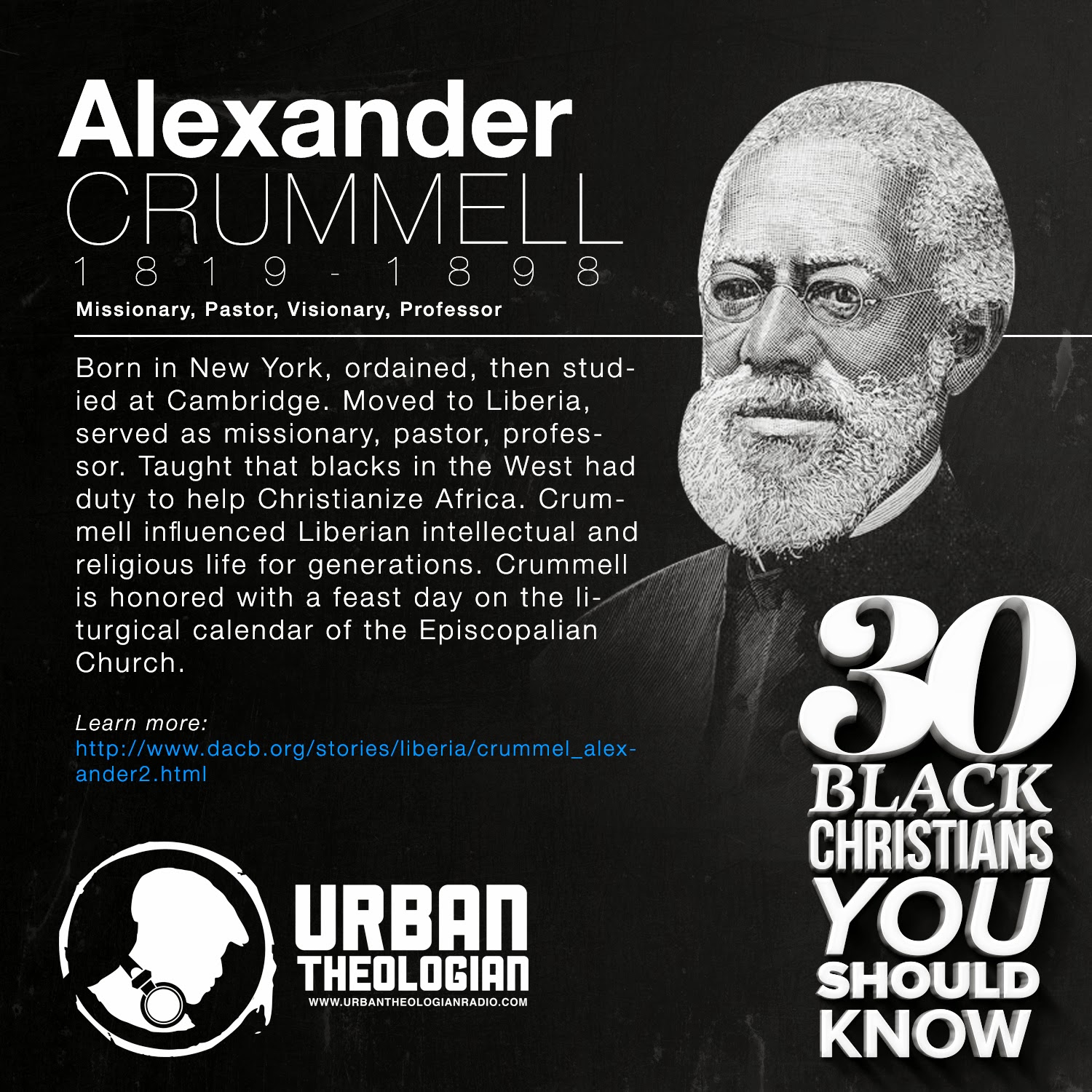
14. Alexander Crummell (1819-1898)
15. John Marrant (1755-1791)
16. Harriet Tubman (1822-1913)
17. Thomas Lewis Johnson (1836-1921)
18. Amanda Smith (1837-1915)
19. George Washington Carver (1864-1943)
20. William Henry Sheppard (1865–1927)
21. Samuel Morris (1873-1893)
22. Francis J. GrimkΓ© (1850-1937)
23. Mary McLeod Bethune (1875-1955)
24. Eliza (Davis) George (1879-1980)
25. Montrose Waite (1891-1978)
26. Efrain Alphonse (1896-1995)
27. Thomas A. Dorsey (1899-1993)
28. Andrew Jackson Foster (1925–1987)
29. Matthew Anderson (1845-1928)30. John Perkins (1930- ____ )

PS - Vocab has another 30 men and women already selected. So if you want to see a Part 2 in 2016, give us a holler.


Our Great Big Formal Announcement


We’re about to launch some great writing from Roosevelt Community Church, and this is our big FORMAL announcement.  Look for Tuesday and Thursday posts on facebook around nine in the morning. (We might begin with an exception today, however, just to get things rolling.) There are a variety of writers coming at you, and I’d encourage you to share widely. We have great stuff coming up on Leviticus and  Zombies, Anxiety and Discipleship.

I'm sticking in a little editorial caveat. These are written by individuals, and do not necessary represent all of RCC thinking. We value our peeps, though, so keep this in mind. I mean, you know, I'm the one they got to edit!

This is an ongoing project, so please submit work to me, RCC people. OUR NEXT DEADLINE IS MARCH 22 AT MIDNIGHT, but submit at any time. Though I can mess with stuff, it’s best if you use 12 point font, Cambria, one-inch margins, and single space. If you need specifics on the submits, e-mail or text me.

Wednesday, February 4, 2015

Witnessing to Family: Urban Theologian Radio Reflection

-->
I’m doing a little combo reflection here, since Randy Newman (the author of Bringing the Gospel Home) guests on both, and the focus is similar in each. Evangelism. Witnessing!
listen at this link: http://goo.gl/e5QCxZ

Yikes.

I wonder—I really do—how the general peeps feel about witnessing.

Do you do it?

Do you like to?

Are you all about the door-to-door thing, or do you keep a low-profile? Do you pull out your Christianity at parties, hound your degenerate family members, show up at deathbeds? How’s the old office witness thing going?

Really, I know that sometimes I’m the one who will to say the candid, albeit slightly skewed, stuff that a lot of people don’t feel comfortable talking about. Like I’ll admit to cussing or I’ll tell people how I couldn’t possibly home school because I suck as both a mom and a teacher, which is pretty funny since I actually am a teacher. BUT: I think I’m going out on a limb here when I say that evangelism is not my favorite thing.

The crazy thing is that, when confronted with this topic, I find myself suffering from writer’s block, which I think is just a great big myth anyway!

I often wonder about evangelism, and how the lives of the folks in Acts are relevant today. Right now, I really only want to pose questions. First, why is it not my thing? Second, do I have a right—biblically speaking—to take such a stance? May I bow out of evangelism?  So, these are, of course, begging a more basic question: Is there a biblical mandate to evangelize?

Matthew 28:19 probably says it best: “Therefore go and make disciples of all nations, baptizing them in the name of the Father and of the Son and of the Holy Spirit . . .” (NIV).

I’m not so sure I can get around that one. I would, though, love to hear how people respond to this commission.

Newman assumes it, and moves on from there. In the first episode, he discusses the process of evangelizing by asking questions. Sounds like the Socratic method to me. This really mirrors Jesus who often answers a question with another question. This not only promotes active engagement rather than a passive kind of distance, but it also has the benefit of revealing insincerity. There’s a difference between sincere discussion and clever, insincere banter. There are plenty of people who enjoy sparring over philosophy, mostly because it can sound pretty smart. But the Socratic method may require sincere engagement.

So where are you?

Do you tell your friends that they’re going to hell, like Elaine’s boyfriend does on “Seinfeld”? Are you Elaine in this? Or Puddy? I’m kinda like George.

In the second radio episode, Newman talks about witnessing to family members. (What’s with all of the “Seinfeld” references?)

I did enjoy the fact that his background was Judaism, so he knew what witnessing to Jewish family members was like. That’s my background, too. I’ve always noted how it seems to me that when a Jewish person converts to Christianity, it‘s somehow one of the most offensive acts possible—right up there with terrorism and child abuse. Or, more accurately, joining a cult. Jesus is an all-out affront; one is turning his or her back on Moses, the Moses. It seems to be a very personal insult against Abraham, Isaac, and Jacob.

This had always been my longstanding impression.

But now I realize, having married a Catholic who went all Protestant, that the Catholics aren’t so thrilled by conversion to Protestantism either.

In both situations, philosophical and religious beliefs are seen as affronts against two things that are, apparently, more important than just about anything else: culture and tradition.

Maybe more attention, then, needs to be focused on the importance of culture and tradition, but the ways in which they're intellectually secondary to belief systems.

In such a climate, I know how I’ve personally responded. I just shut up, to be honest. I like the Jewish people and the Catholic people in my life. Fun traditions, appealing culture! I don’t really want to mess with that!

I'm not in a cult!

At least, I'm not right now!

Still: there is the nagging existential stuff. How does the meaning of life fit in?

I get a little schizophrenic. Forget the meaning of life! Can’t we just celebrate Christmas with some uber-Catholic panache and eat some potato latkes? Spin the freakin’ dreidel!

Really, let me just admit to my own hesitancies (failures?), my own inadequacies (failures?), and my own distaste—it is distaste, folks—for an in-your-face witnessing style that presents Christianity in a disingenuous way. What is a disingenuous way? Have you thought about this? What is an effective witness? Is there a quiet witness? How do you feel about leaflets?

Are you with me?

This time, I’m asking for feedback. Where do you stand on evangelism and witnessing?


Written by RCC member Jennifer Bell