Showing posts with label Church History. Show all posts

Monday, March 2, 2015

30 Black Christians You Should Know: Complete Edition

30 Black Christians You Should Know: All 30!

This unique series - 30 Black Christians You Should Know - was sponsored and promoted by URBAN THEOLOGIAN RADIO. Vocab did the research and created the text for each digital card. Akande Davis of Advent Media provided the graphic design. Megan Rose released the images on social media. You can download and use them for teaching purposes. Do not sell, they are meant to be free. Give Urban Theologian Radio a shout out if you use them. 
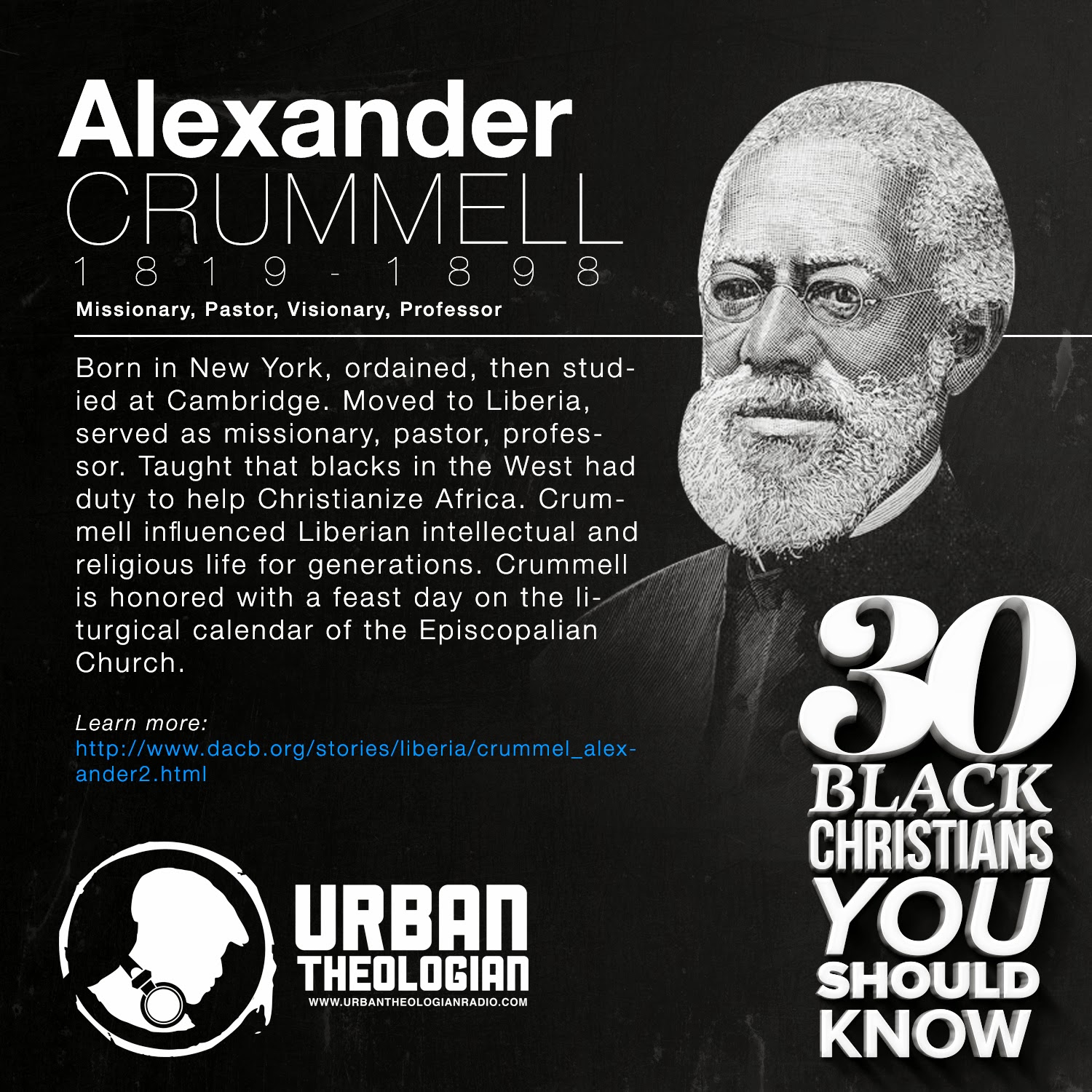


 This is the list in the order in which we released them. It is roughly chronological. *the pictures above are in a different order: alphabetical order, by first name.

1. Lemuel Haynes (1753-1833)

2. Benjamin Banneker (1731-1806)
3. David George (1742-1810)4. Oladuah Equiano (1745-1797)
5. Absalom Jones (1746-1818)
6. George Liele (1750–1820)
7. Phillis Wheatley (1753-1784)
8. Daniel Payne (1811-1893)
9. Richard Allen (1760-1831)
10. Lott Cary (1780–1828)
11. John Stewart (1786-1823)
12. Betsey Stockton (1798-1965)
13. Frederick Douglass (1818-1895)
14. Alexander Crummell (1819-1898)
15. John Marrant (1755-1791)
16. Harriet Tubman (1822-1913)
17. Thomas Lewis Johnson (1836-1921)
18. Amanda Smith (1837-1915)
19. George Washington Carver (1864-1943)
20. William Henry Sheppard (1865–1927)
21. Samuel Morris (1873-1893)
22. Francis J. Grimké (1850-1937)
23. Mary McLeod Bethune (1875-1955)
24. Eliza (Davis) George (1879-1980)
25. Montrose Waite (1891-1978)
26. Efrain Alphonse (1896-1995)
27. Thomas A. Dorsey (1899-1993)
28. Andrew Jackson Foster (1925–1987)
29. Matthew Anderson (1845-1928)30. John Perkins (1930- ____ )

PS - Vocab has another 30 men and women already selected. So if you want to see a Part 2 in 2016, give us a holler.


Monday, July 30, 2012

Study Questions for July 29, 2012 Sermon


Study Questions for July 29, 2012
Sermon: “We Believe in the Holy catholic church”
by: Bob Korljan
Series: What We Believe - Preaching through the Apostle's Creed
1. True Christian unity comes from each believer being in Christ - not from allegiance to some specific organizational structure. With this in mind, read John 17:11, 17, 21-23 and Galatians 3:28.
Think and speak of the ways you see this truth and these verses played out in these areas:
-Across the globe?
-In your city?
-In your own local church?
-In your own personal life?

2. Read the following excerpt (adapted from J.I. Packer):
            NOTE: We interpret “catholic” in accord with its literal meaning, “universal.”
The church is the one worldwide fellowship of believing people whose Head is Christ.
It is holy because it is consecrated to God.
It is catholic because it embraces all Christians everywhere.
It is apostolic because it seeks to maintain the apostles’ doctrine unmixed.                                                                                                                                                        
   
-Does this make sense to you?
-Is it helpful? Explain.
-Talk as a group about this paragraph and its implications.

3. Look over 2 John 7-11 and Galatians 1:18-19 and answer these questions from the texts:
-Should there be a limit to our unity?
-Why?
-If so, what are these limitations based on?
-If there are limits to unity, what are some things we as Christians should not do?


OPTIONAL QUESTION
In John 10:16
-Who is the one flock (Ephesians 2:14-16 may be helpful)?
-Who is the one shepherd (1 Peter 5:4 may be helpful)?
- What is the significance of this for: each individual Christian? each local body? the church worldwide?

DEVOTIONAL
-Tomorrow please read Ephesians 2:11-4:16.
-Write down some things to pray about from this passage.
-Pray!

The Apostles’ Creed

I believe in God the Father Almighty; Maker of heaven and earth.
And in Jesus Christ his only Son our Lord; who was conceived by the Holy Spirit, born of the virgin Mary; suffered under Pontius Pilate, was crucified, dead and buried; the third day he rose from the dead; he ascended into heaven; and sitteth at the right hand of God the Father Almighty; from thence he shall come to judge the quick and the dead.
I believe in the Holy Spirit; the holy catholic Church; the communion of saints; the forgiveness of sins; the resurrection of the body; and the life everlasting. Amen.

Sunday, September 4, 2011

Notes from 'Critics of the Early Church' [Roosevelt Institute Class]


ROOSEVELT INSTITUTE CLASS
“CRITICS OF THE EARLY CHURCH”
09/03/2011

Summary of some of the main pagan criticism of the early church:
1.       The doctrine of the resurrection is absurd
Example: Acts 17, 1 Corinthians 15
2.       There are contradictions in the Scriptures
Example: Porphyry, Thallus
3.       Atheism is widely held
Example: The Martyrdom of Polycarp (8.2; 9.2; 10, 1), a trial under Domitian
4.       Christianity is the worship of a criminal
Example: Early art mocking Christian worship, 1 Corinthians 1:21–25
5.       Christianity is a novelty
Example: Suetonius (Nero 16.2)
6.       Christianity evidences a lack of patriotism
Example: Pliny the Younger (Epistles 10.96.3-4), Tacitus (Annals 15.44)
7.       Christians practice incest
Example: Cornelius Fronto
8.       Christians practice cannibalism
Example: Athenagoras, Justin Martyr
9.       Christianity leads to the destruction of a society
Example: Decius, Diocletian and Julian
10.   Christians are ignorant and arrogant
Example: Celsus, Lucian of Samosata

*This list is adapted from the helpful “The Arguments of the Apologists” in Robert C. Walton’s Chronological and Background Charts of Church History, revised and expanded edition (Grand Rapids, MI: 2005), Chart 15.

Friday, August 26, 2011

Gregory Nazianzus: Human Life is Brief

This Sunday we will be looking at Psalm 103, which includes the following verses:
15As for man, his days are like grass;
   he flourishes like a flower of the field;
16
for the wind passes over it, and it is gone,
   and its place knows it no more.
17
But the steadfast love of the LORD is from everlasting to everlasting on those who fear him,
   and his righteousness to children’s children,
18
to those who keep his covenant
   and remember to do his commandments.
A well known figure in church history is Gregory Nazianzus. His brother Caesarius died around A.D. 369 and for the funeral Gregory said this as part of his speech there:
Such, my brethren, is our existence, who live this transient life, such our pastime upon earth: we come into existence out of non-existence, and after existing are dissolved. We are unsubstantial dreams, impalpable visions, like the flight of a passing bird, like a ship leaving no track upon the sea, a speck of dust, a vapour, an early dew, a flower that quickly blooms, and quickly fades. As for man his days are as grass, as a flower of the field, so he flourisheth. Well hath inspired David discoursed of our frailty, and again in these words, "Let me know the shortness of my days;" and he defines the days of man as "of a span long." 
Gregory takes his cues from David here. What a sobering reminder of our mortality.
Come this Sunday at 10am to hear more about this!

 SOURCE: Gregory Nazianzus: Panegyric On His Brother S. Caesarius.Oration 7.19.  

Monday, May 17, 2010

The Unquenchable Flame: Discovering the Heart of the Reformation

The Unquenchable Flame: Discovering the Heart of the Reformation by Michael Reeves
A Review by Dennae Pierre

The Unquenchable Flame by Michael Reeves gives us a glimpse into a world where “justification by faith alone” was a truth that had been "hidden" from the Christian world for a long time. It reminds us there was a time when hundreds of years passed in which believers had little direct access to the Bible and were often at the mercy of a priest to explain God’s living word to them.

This work reminds us that Luther, Zwingli, Calvin, Tyndale, Knox, and many others spent their lives and often died for the Reformation. They did so because they knew that central to the heart of the gospel is the fact that we can only be justified (be made right with God) through the blood of Christ Jesus. They ached for people to know that they could not merit God’s favor through works and good deeds.

A basic understanding of the Reformation should drive each of us into God’s word with greater fervor. As a Puritan once said,

“Lord, whatsoever thou dost to us, take not thy Bible from us; kill our children, burn our houses, destroy our goods; only spare us thy Bible, only take not away thy Bible.”

This statement may sound extreme in a Christian culture where we all have multiple Bibles in our home yet still “struggle” to find the time or the desire to read God’s word but, as Reeves explains “for the Puritan, the Bible was the most valuable thing this world affords.” How I pray that would be true for me as well!

I just finished reading this book and enjoyed every paragraph. If you love history, especially church history, you will enjoy this book. If you don’t like to read and especially do not like history, I still think you will enjoy this book because Reeves uses words to paint such a vivid picture of the Reformation.