Thursday, August 28, 2014

BACKPACK RADIO REVIEW: "The Vermon Trilogy" (11/17/13) Episode #165:

-->

Vermon Pierre, the lead pastor of Roosevelt Community Church, wrote three blog posts for the Gospel Coalition. They’re related, maybe.

As I thought about it—and I’ve actually been thinking a lot about it, personally, because it’s part of the fiction I’m working on—there is a common thread: how we define our own sense of self. Personal identity. What does it mean to be individuals, and what does it mean to be in a church? Is one more basic than the other? Is one subjugated by the other? Who are we, basically, within the Body of Christ? And, then, who is this Body? (Poor Pastor Vermon. I’m probably taking his totally normal ideas here and using them to serve my own psycho agenda. He’s all like, I’m just talking about suits and ties! Who said anything about the subjugation of self?)

Go with me on this, because I’m not going to do too much more than raise questions.  My own reflection here is a little jumbled. I’d really welcome your responses! Here are the original blog posts:

1: “The Awesome Church”
2: “Don't Throw Out Your Nice Suit Just Yet”
3: “Why I Wanted to Go to the Million Man March”

The Awesome Church: In this first piece, Vermon speaks about how we’ve entered this era in which it’s super easy for the church to self-promote through social media. The minutia of church life, as well as the big stuff—sermons, for instance—is instantly available online, to all. So, here, are some questions for you to discuss amongst yourselves:  

Should social media be used by churches, and how? Is this part of transparency? While self-promotion is not so hot, what about the opposite extreme: churches acting as “secret societies,” in which you’ve gotta be “plugged in” (see, I’m using the lingo) to get access to the good stuff? If not painting an awesome picture of all of the amazing accomplishments of your church, what picture of the church should we be painting? Is the minutia wrong?

I kinda like minutia. Though that may just be me.

What in the world does this have to do with personal identity or the subjugation of self? Well, let’s see . . . Is there something wondrous about the ability to assert our sense of self in the contemporary technological age—or it necessarily narcissistic? What are the implications of self-assertion? Is it ever appropriate? Individually, we want to have a personal identity, right? Isn’t this part of being made in the Image of God? Weren’t we created specially, personally, individually? Is the desire to be known connected to self-promotion? In the Bible, we’ve got those not-so-veiled references to sex, in which a man knows his wife. We’ve all seen those parts. I think I breezed over one the other day when reading to my kids. There’s the sex, yes. But what else is implied in knowing someone intimately? Are we trying to be known on social media? Are we trying to define our personalities? Do churches have personalities? Is marketing good, desirable? Is it the same thing as promotion? How might this be distorted by narcissism and sin? Is it always narcissistic to publicly define ourselves or our church? Where is the fine line between self-promotion and humility?

And what do you think about the ice bucket challenge?

Don’t Throw Out Your Nice Suit Just Yet: Here, Vermon talks about how clothes make the man? No, he talks about the way our clothes in churches speak, often enough, to other Christians. Seeker-friendly churches (are we all to be “seeker-friendly”? Just what is that anyway?) might be sensitive to appearances. We dress up for the traditionalists. We dress down for the hipsters.

On the show—I could be wrong here—it seemed as if the guys were slightly dismissive of one response to the blogs that suggested we might want to dress up as if we’re meeting a king. We’ve sorta lost the awe of meeting royalty, the guy implied. I think this response might’ve been a little blown off as being beside the point. Though I’m wondering if that is the point: we should dress for God, not the people?

I need to be honest here. I don’t like dressing up for church one bit. I like my blue jeans very much. Out of four Sundays in a month, I’ll wear nylons (yuck!) maybe once. So, tell me something: should we be dressing up? Am I failing to properly teach my kids something by letting them wear their shorts and jeans?

As far as personal identity goes, how are clothes related to identity? If our identity is in Christ, what should we be wearing? Besides the obvious jokes I’m not going to make about tunics and Birkenstocks, what about that other stuff—like women covering their heads? Do we have to talk about that? (I don’t really want to.)

Why I Wanted To Go To The Million Man March: In this final post, Vermon talks about the significance of the multi-demographic makeup of churches. This raises some interesting questions about cultural identity.

I’m just going to give you his wife’s recent blog post, which I sorta love: Dennae Pierre’s “on what marrying a black man has taught me & why Ferguson matters (part 1).” One reason why I love it is because Dennae talks about how she used to think to herself, prior to her marriage, as someone who’s—quite simply “got it.” I know I’ve totally thought the same thing about myself, even though I like to say I’m married to the whitest guy on earth (this really isn’t true, I’ve learned). As it turns out, we may not have it like we think we do. I think we are way too dismissive of the significance of cultural experience. Becoming a member of the Body of Christ doesn’t negate our individual identities.

So where does cultural identity come into play when talking about our sense of self? Is this something that should be ultimately insignificant when we’re talking about the Body of Christ? I think we’re at the point when we’d say it is significant, but how? Why? This is another unique aspect of who we are as individuals. To what extent is this to be brought up, and to what extent is it to be subjugated?

I hate that word, actually. But I’m trying to make sense of personal identity.

This radio show, and Vermon’s blog posts, create a forum for discussion—not just on churchy stuff, but on what individuals within the body are like.

Tuesday, August 19, 2014

God Abandoned - Sermon Study Questions

The Gospel in Poetry - A Series in the Psalms
Sermon by Andrew Stravitz
You can find the sermon at rooseveltchurch.org.

Psalm 22
  1. My God, my God, why have you abandoned me?
  2. Where do you usually turn in your darkest hour? Do you usually turn to God in the darkness? Why or why not?
  3. Does the hope of life after this life, with the congregation of all families, give you courage in the midst of your darkest seasons?
  4. In what ways is it a comfort that Jesus suffered in all the ways that we suffer, and was tempted in all the ways we are tempted?

God Abandoned from Roosevelt Church on Vimeo.

Monday, June 16, 2014

Presuppositionalism and Beauty | Backpack Radio Reflection Episode #111


I turned to the archives for this episode because it was categorized under “Art.” Hey, I like Art! I want to talk about Art! Give me some Art!

Okay, so, like, after listening, a commoner like myself might ask—in the fashion of that oldie-but-goodie commercial for Wendy’s in which the elderly lady asks Where’s the beef?—“Where’s the Art?”

It’s there, folks. But you gotta listen. You’ll need to make some inferences. You’ll need to put two and two together. Plus, there’s a little something specific at the end.

This episode focuses on the “Presuppositional Apologetic Method,” and the guest is Lindsay Brooks, deejay/musician/apologist (Artist!). Brooks was very articulate, and engaging. Though I wanted more arttalk, I can see—I acquiesce—to the importance of doing groundwork first. In order to properly discuss the meaning and nature of Art (notice how I’m using a big “A” throughout), one must understand the context of the conversation.

Brooks points out that when the Apostle Paul moves into his own discussion process, if you will, in Acts 17, he does something pretty radical; he begins with the premise that the One True God exists. In a sweeping and rather bold move, Paul removes all idols by simply not acknowledging their legitimacy. Wow! Basically, the bedrock of this apologetic method, then, is sola scriptura: the Bible is the ultimate authority on life.

Allow me to try to identify some important terms and people that keep coming up in my commoner’s life, even though I try—often enough—to suppress the truth in unrighteousness:


  • Presuppositionalism: we inevitably, inescapably begin all discussions with presupposed notions. We cannot not come to the table with a set of defining beliefs. Are we really ever able to objectively escape ourselves, or do we carry our worldviews with us? This is more associated with Reformed types.
  • Evidentialism: I think I am personally going to dub this the “Show Me The Money” apologetic method (and if you don’t know to what that is referring, I am definitely the wrong girl for you). This is the idea that evidence is what leads to belief. If you can cough up the evidence, you can sway the masses. This is more associated with Fundamentalism and the Christians you might meet with tracts and stuff (though Reformed types sometimes have tracts too). These folks are more likely to show up with a dinosaur bone, as well.
  • Cornelius Val Til: big thinker, articulator of presuppositionalism. Why don’t we name our children “Cornelius” anymore? Wasn’t that one of the ape’s names in the great classic movie, Planet of the Apes? 
  • Greg Bahnsen: His mentor was Van Till. He carried the torch. “The Transcendental Argument”: Knowledge and logic are only possible if there is a God. This gets pretty confusing, but it makes sense. How can linear, sensical thought even happen without an Absolute? So, like, God makes rationality possible. Ho Hey, as The Lumineers might say. 

There you go. Theology made easy! I need help from the big guys!

So, one thing you might especially take away from this is that presuppositionalism would imply there is no such thing as neutrality. We cannot really be neutral about anything. We have our presuppositions with us at all time.

Onto Art!

Um, I heard hints of it. Lindsay Brooks began formulating his ideas on universals, his understanding of a beauty that is transcendent. In my favorite quote from the episode, he said, “I live and breathe the pursuit of the awesome.”

That’s awesome, right there.

I liked where we were going. I’m ready for a little more. How does Art fit in? What role does objectivity play in beauty?

Really, there’s so much to say on Art. Is there such thing as “good” Art? How is that defined? By whom? What is “bad” Art? What is the purpose of Art? Ah, Art. The pursuit of the awesome!

Jennifer Bell is mostly a writer, but she's also an English teacher. The author of two books of fiction, she lives with her husband and two kids in Phoenix.

Tuesday, May 13, 2014

Food for the Hungry - Lakartinya Update

Food for the Hungry - Annual C2C Report 2013
Lakartinya, Kenya

1.      Greeting from Community – Officer- Mr. Wario
I thank the almighty God for granting me this opportunity to send a word of “hello!” to Roosevelt Community Church. I’m well together with my family and the community in which I’m working. Our community received good rain the whole of the year 2013. The school is growing in terms of infrastructure and increased enrolment. I hope that you are fine too and I wish you more blessings from God.

2.      Prayer Requests and Answered Prayers
a.       The Lakartinya community prayed for peace when there were fears of raids from other communities in the course of 2013. Cattle raids are unfortunate cultural practices that lead to death and destruction. We thank God that He granted peace, and that the fear is gone. People are now moving on about their daily affairs with increased freedom, secure in the knowledge that God has granted them safety. When the Workteam visited Lakartinya in 2013, one of the training sessions for Morans (young men or warriors) was on how to live peacefully with other people since all were created in the image of God. Since then none of the Morans from Lakartinya have been heard to participate in raids. Therefore the community also thanks God for the changes evident in their young people and pray that the Holy Spirit will continue ministering to the young people’s hearts to always choose the way of peace.
b.      As the school enrollment increased, there was an urgent need for latrines. The community prayed for resources to address this need. God answered these prayers, because by the end of year 2013, two latrines had been constructed through funding by a development partner. The latrine is expected to last for a long time because it was made in a way to allow for emptying after a certain period of time.
c.       Access to water is an ongoing request in the community, in 2013, God answered this prayer by providing a water dam near the community that is expected to harvest sufficient rain water to last the community for up to four months after rains.
d.      The community continues to pray for the AIC church chairman, who was mauled by a hyena and lost one jaw and crushing of his nasal system among other injuries. They thank God for preserving his life and enabling him to continue to serve his family and the community despite the limitations of the injuries. He is a real testimony of God’s amazing grace in living against all odds. They continue to pray that ways will be opened for him to recover full use of his jaw and nasal system.

3.      Impact of US Church
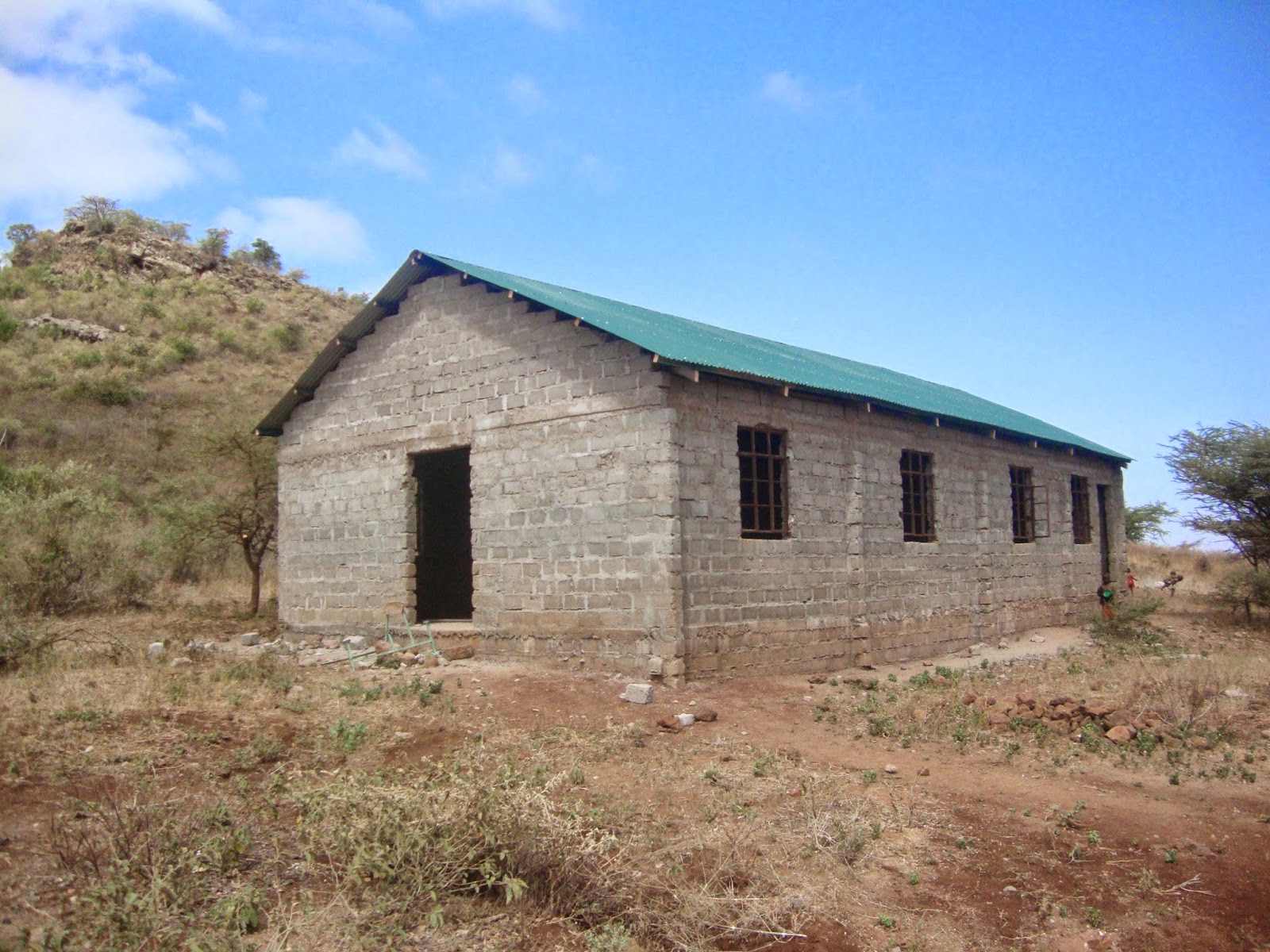
The church building that is still under construction with funding from your church continues to inspire members to contribute toward its completion. The church members have a goal to complete the building no matter how many years it takes. They are continually motivated by the love shown by Roosevelt Church. The community is now looking forward to having 6 complete classrooms. Roosevelt Church supported construction of three of them while the government of Kenya supported construction of the others. Children always have a classroom to learn in as they proceed to higher grades. There are many children from the community who have been supported to access secondary education though payment of school fees. Some have come back to the community to inspire and mentor other children to work hard in school no matter the challenges so that in future they will be in a position to contribute back into the community. Through child sponsorship, FH has equipped the teachers to have regular life skills training sessions for the children as well as Bible study. In addition, through home visits parents are encouraged and motivated to support their children in school and cater for their health needs. As a result there was increased regular attendance in school. It has been noted that the more educated people there are in a community, the better the well-being of all the people in that community. Therefore by encouraging and supporting the children to remain in school and supporting others to proceed to secondary education; there is investment in the future well-being of Lakartinya community.

4.      Church in the Community
The local Church in the community increasingly took up the role of teaching the word of God to the children at Lakartinya School in Bible study sessions and in the pastoral program of instruction [PPI] where the school curriculum sets time every week for religious instruction of children. In December 2013, the local church conducted youth camp where over 70 young people attended. They were sensitized on such topics as holistic living, how to engage in community development and ways of handling conflict.


5.      Politics, Government, and Associations
There were general elections in Kenya in March 2013 which ushered in a new form of governing. Since then there have been slight changes in what is previously known as local government and now called county government. The rules of engagement are still not clear but there are bound to be changes in future. However, the government did resource and thereby complete the stalled projects of the previous government. It took some lobbying to get the government to complete the stalled classroom in Lakartinya school but it also opened up the door for the community leaders to create networks with the County government. This is a great opportunity that the community is looking forward to utilize for their development. The community was supported to contact other partners who funded construction of latrines. This way the community is learning to seek and make beneficial partnerships with development partners.

6.      Changes in the Community – include at least 1 spiritual/worldview change 
and 1 physical change
Cattle raiding from neighboring communities was a practice that was widely practiced among members of the Lakartinya community. The young men would plan and undertake a raid, justifying themselves that it was the fault of the other community for not having better protection. They would also use this action to prove their ‘man-hood’. But since FH began walking with the community, there has been a shift in way of thinking so that now the community state that there is no value in undertaking cattle raids. The young men are also changing their mind sets on this matter and during feedback meetings with them, they have begun indentifying other ways of earning honor and respect among each other. One way that they now practice their ‘man-hood’ is supporting the Kenya Wild life service in monitoring movement of elephants. The young men are good trackers and they are using this skill to support conservation of elephants.

7.      Staff Changes
There have been no changes in staff.

8.      Update on Critical Issues from the Community Transformation Plan –update on at least 2 
of the 4 sectors of CFCT: livelihoods, health/nutrition, education, disaster risk reduction.
a.       The critical issue of poor health seeking behavior is slowly being addressed. More and more parents are taking their children for treatment in the nearest dispensary. Parents have been equipped with knowledge and skills of providing good nutrition to their children especially during the rainy season when cattle provide a lot of milk. There are a few parents who have adopted a practice of first providing sufficient milk for their families and selling the surplus in the market.

There is still more work to be done to improve the community’s practices on good sanitation and hygiene. The challenge of difficult access to water in the dry season hampers good hygiene practices. However, it is expected that with the improved access to water from the newly dug earth dam, it will make it easier for the community members to adopt good hygiene and sanitation practices.

b.      Education is becoming very important to each and every one. It is one of the most expensive sectors where those who live below the poverty level cannot afford to send their children to secondary school and colleges. In Lakartinya, parents have increasingly indicated their value for education by sending more and more children to school. From a community that had no school, to one with over 300 children enrolled, the positive change is evident. The school leaders have also constantly lobbied for additional teachers so that in by the end of 2013, two additional teachers were posted to the school. Meanwhile parents are very supportive of all initiatives that concern the education of their children; for instance they provided unskilled labor when there were delays in accessing government funds to complete one classroom construction in 2013.

9.      Personal Example of Positive Change in the Community
Aaron is a hard working young person Lakartinya community. He had dropped out of college due to lack of fees. Since access to electricity is limited to few individuals, Aaron heard that there were ways of making use of the sun to generate solar power. He followed up on how he could do so with an eye of creating a business opportunity.

Through FH support, he accessed the information he needed, sold a few livestock to purchase batteries and solar panels. He then begun business as a barber and later diversified to other services that require power such as photo copy and developing of photographs. Within one year he had made sufficient funds to employ someone to run the business as he went back to college to complete his course. He is now able to pay the college tuition fees.

Aaron has now become a positive role model for both the children and adults in Lakartinya community. They have seen evidence that GOD can enable one to overcome challenges in ways that are unique yet profitable. This is a theme that is discussed in many of the life skills training and Bible study sessions.

10.  Activities in the Community – List 3 FH activities that have occurred in the 
community in the past 6 months, ASIDE FROM team visits:
a.       Life skill training for children and youth- The participants were engaged in lively discussions on how they can improve their lifestyles by adopting godly mindset and behavior
b.      Construction of classrooms- Parents were motivated to support completion of one classroom by providing casual labor and they begun clearing ground for another to ensure that the vehicles transporting construction materials would be able to move easily.
c.       Home visit to equip parents with simple skills to improve their children’s hygiene and sanitation.

Dear Roosevelt Church,
Thank you so very much for your dedication and commitment to the amazing work you have accomplished this past year in the community of Lakartinya. We here at FH are very proud and honored to work with your church in Kenya, Africa. I hope that this reports helps provide great information back to you to show the progress that has been made as a result of the great work you have poured into this wonderful community. Thanks again so much! Many blessings to you all.
In His service,
Ryan
Church Engagement Representative for Food for the Hungry

Report Submitted by Zipporah from Food for the Hungry Kenya


Thursday, May 1, 2014

Kill Your Youth Group! | Backpack Radio Reflection Episode #35

Kill Your Youth Group! [05/29/2011]
  • In which Pastor Vermon says, “I’m black, so I’m naturally cool.”
  • In which a question is begged: Is the Gospel boring?
  • In which we learn the meaning of  “adultolescence” and it hurts.
I listened to this one because I’m scared of teenagers. Even though the rumor is that I once was one, and even though I spend a chunk of my day with them. Just today, in fact, I sat behind a desk and listened to them positively butcher Shakespeare’s The Merchant of Venice (I’m a teacher). And yesterday, I heard the following snippet of conversation about the movie Gravity:

Jane: "I'm never going into space."
John: "Jane, you may be forced to one day."

They’re amusing creatures, aren't? The problem is that I’m just not there anymore, and so they’re a little mysterious too. I used to speak the language of rock n’ roll, but my rock n’ roll is passé now. Once upon a time, I related to the emotional and moody ones, but Kurt Cobain is dead, kids aren't really so angst -y anymore, and now I think like a mom. Plus, the gospel of my former teenaged self is not a gospel worth spreading.

So, there’s this problem: how do we meet teenagers where they’re at, and how do we meet them with Truth?

This episode tackled my problem.  First, let’s follow Pastor Bob’s lead in making sure we identify the show’s subtitle, lest you think this broadcast is a recipe for murder. The subtitle is “The Steady Decline of Faith in Youth.” Teenagers raised in the church are leaving the church. When they grow up, they take off. The Youth Groups aren't working.

The introduction to the show included some daunting stats.

According to a 2002 Southern Baptist Council on Family Life study, about 88% of Evangelical Christian kids leave the church shortly after high school. Other studies are not encouraging.

Then, a group of sociologists, including Christian Smith, the co-author of Soul Searching: The Religious and Spiritual Lives of American Teenagers (2005), has dubbed the belief system of these teenage Christian casualties Moralistic Therapeutic Deism.  Moralistic Therapeutic Deism is expressed in the following (kinda quoted, kinda paraphrased) five tenets:
  1. There is a God.
  2. God wants people to be good.
  3. The main purpose of life is to be happy.
  4. God doesn't need to be involved in our personal lives unless we’re in a bind.
  5. Good people go to heaven.
So what’s the deal?

Vermon offers a good critique, suggesting that there’s a difference between the Youth Group and a Youth Ministry. Jim Rayburn, the founder of Young Life, is quoted as saying, “It’s a sin to bore a kid with the gospel.” The implication is that too much theology and too much Bible and too much talk of sin is boring. This, of course, begs the question, Is the Gospel boring?

Vermon emphasizes the need for the real Gospel, rather than one belonging to an “emaciated God.”

One last thing to spark your interest. The Backpack guys mention how the “teenager” is a modern concept and how we've even extended our youth to include “adultolescence”; our twenties are now designated as our time to find ourselves. We postpone responsibility.

I know I definitely postponed adulthood in my twenties, which really shook things up when I ended up married at thirty-four and a mom at thirty-six. I was, if you must know, forcibly removed from my search for self by a tragic car accident at twenty-eight (in Africa! Where I was finding myself!). Which was too bad, because I had been hoping to backpack through Latin America at some point, and I was thinking of going for another college degree because I still wasn't entirely sure what I wanted to be when I grew up—though it might involve animals or photography, as long as no math were involved.

Here’s the thing, which the show does touch upon: Youth Group Culture, with its emphasis on a fun albeit shallow and transient time, is focused on self. It naturally leads to adultolescence. Adultolescence may be the saddest thing of all, since one can at least say about teenagers, “Well, they’re just kids.” Can’t say that about the adultolescents out there!

How do you fix it? What does it mean to be God-centered rather than pizza-oriented? What is a vital youth ministry? How do we speak to where kids are without catering to the places they do not need to be? Does that make sense?

Teenagers are special. Despite my removal from their reality, I get this. I have a sense of their topsy-turvy psyches, their seemingly unique and nameless longings, their new abilities. They too hunger and thirst. But the pizza will not cut it.

About Vermon’s quote on being cool, I just wanted to include that one.

Jennifer Bell is mostly a writer, but she's also an English teacher. The author of two books of fiction, she lives with her husband and two kids in Phoenix.

Thursday, April 3, 2014

1 Corinthians 15 - Sermon Study Guide

  The sting of death is sin, and the
power of sin is the law. But thanks be
to God, who gives us the victory
through our Lord Jesus Christ.
Therefore, my beloved brothers, be
steadfast, immovable, always
abounding in the work of the Lord,
knowing that in the Lord your labor
is not in vain.
(1 Corinthians 15:56-58 ESV)


(Click here for the PDF Version of the study guide.)

1 Corinthians 15: THIS IS WHY WE WIN
1 Corinthians Introduction (English Standard Version)
The city of Corinth was at the heart of an important trade route in the ancient world. Like many cities that thrive on trade, Corinth had a reputation for sexual immorality, religious diversity, and corruption. The church that Paul planted there (Acts 18) floundered under all of these influences and began to divide over various issues. First Corinthians addresses many practical questions dividing the church—questions concerning such things as spiritual gifts, marriage, food offered to idols, and the resurrection. Paul urged the Corinthians to be unified and to give themselves fully to “the work of the Lord” (15:58). Chapter 13 includes a well-known passage on the nature and importance of love. Paul wrote this letter to the Corinthians from Ephesus about a.d. 55.
1 Corinthians 15 Chapter Introduction
The doctrine of the bodily resurrection of Jesus Christ is the heart and center of Christianity. Without the resurrection, Christianity is wishful thinking or empty speculation.
1 Corinthians 15 focuses on the Corinthians’ confusion about their own resurrection - Paul was not trying to convince them that Christ rose from the dead - but that one day they, too, would be raised with Christ to eternal life.

Chapter Breakdown

  • Verses 1-11: to lay the foundation, Paul reviews the evidences for Jesus’ resurrection.
  • Verses 12–34: the implications of denying the resurrection.
  • Verses 35–49: the question of how a general resurrection could even be possible.
  • Verses 50–58: Paul’s closing “Victory Song” and an exhortation for holy living.
Intro material adapted from Macarthur Bible Studies: 1 Corinthians

1 Corinthians 16 Chapter Breakdown

  • Counsel concerning the collection for the poor (16:1–4) The flow of the previous chapter, from a prolonged discourse on doctrinal matters to a concluding exhortation on practical diligence, moved smoothly to a discussion of a practical expression of that faith—care for the needs of others and in particular, the needy in Jerusalem.
  • Counsel concerning future visits (16:5–12) The mention of his planned arrival in connection with the collection sparked another brief digression on the subject of future visits.
  • Exhortation on appropriate conduct and commendation (16:13–18)
  • Salutation, imprecation, and benediction (16:19–24)
1 Corinthians 16 Chapter Breakdown from THE Bible Knowledge Commentary


March 09, 2014
1 Corinthians 15:1-11 Community Group Discussion Guide

GROUP DISCUSSION QUESTIONS
1.      List and discuss 1 or 2 key aspects of the Christian life found in verses 1 and 2 of 1 Corinthians 15:

2.      What are the main tenets of the gospel found in verses 3 and 4 of 1 Corinthians 15? Why are these important?

3.      Why did Paul consider himself to be the least of the Apostles (see 1 Corinthians 15:9)? How does that truth about his past relate and apply to your life and your past? To the life of others?

GOING DEEPER STUDY QUESTIONS
4.      What eyewitness evidence did Paul cite as proof of Christs resurrection? (verses to consider: Matt. 28:9; Mark 16:9; Luke 24:31–39; John 20:19–20; Acts 1:22)

5.      How does the Old Testament support the New Testament doctrine of the resurrection? (verses to consider: Ps. 16:8–11; Ps. 22; Is. 53; Hos. 6:2)

*questions adapted from 1 CORINTHIANS: MACARTHUR BIBLE STUDIES

March 16, 2014
1 Corinthians 15:12-20 Community Group Discussion Guide

GROUP DISCUSSION QUESTIONS
1.      What are the logical implications if the resurrection is false, if Jesus Christ did not resurrect from the dead? According to 1 Corinthians 15:13–19, what would the consequences be if Christ had never risen from the dead?

2.      Think about the most mournful funeral youve witnessed? What made it so sad?

3.      What was the most joyous and hopeful funeral youve attended? What made it such a time of encouragement?

4.      How does the certainty of Christs resurrection give you hope and strength today?

PERSONAL REFLECTION
5.      Which historical event would you most like to have been an eye-witness of:
·         creation
·         the flood
·         the exodus
·         the birth of Christ
·         the crucifixion
·         the resurrection
·         some other?

·         Why?

*questions adapted from 1 CORINTHIANS: MACARTHUR BIBLE STUDIES

March 23, 2014
1 Corinthians 15:20-28 questions

GROUP STUDY (consider breaking up into groups of 2-3 people for about 15 minutes):
1.      As best as you can, put these 8 verses in your own words … if you are able to be really creative, attempt to turn these verses into song lyrics or even a prose poem…

GROUP DISCUSSION QUESTIONS
2.      If you polled your neighbors or co-workers or fellow students regarding their views of the afterlife, what sort of opinions do you think youd uncover?

3.      What reasons do you think your associates would give for holding their respective views on what happens after physical death?

4.      How can the truths in this chapter bring comfort and hope to the heart of someone who has lost a believing loved one?

GOING DEEPER PERSONAL STUDY QUESTION
5.      Look over Revelation 20-22. How does this inform your understanding of 1 Corinthians 15:24:-28? What is the “big picture” these passages “paint” together? What does it “look” like?

*questions adapted from 1 CORINTHIANS: MACARTHUR BIBLE STUDIES

March 30, 2014
1 Corinthians 15:29-34 Study Questions

GROUP DISCUSSION QUESTIONS
1.      How does the truth of the resurrection provide an incentive for both service and sanctification (vv. 30–34)? (verses to consider: Rom. 8:18; Heb. 11:32–40)

2.      Spend some time thinking and discussing the implications of this line in 1 Corinthians 15:32: “If the dead are not raised, ‘Let us eat and drink, for tomorrow we die’.”

3.      How does a person’s view on the afterlife affect the way they live now?

PERSONAL REFLECTION QUESTION
4.      How can your lifestyle be a gospel witness to a culture enamored with eating and drinking?

GOING DEEPER STUDY QUESTION
5.      What does it mean to baptize for the dead? Give some possible ideas about what this is doing here in the text – what purpose does this serve and what is Paul saying to the Corinthians? (This is a great time to utilize any good study bible notes you may have!)

*questions adapted from 1 CORINTHIANS: MACARTHUR BIBLE STUDIES

April 06, 2014
1 Corinthians 15:35-49 Study Questions

DISCUSSION QUESTIONS
1.      What illustration does Paul use to show the resurrection makes sense and is not illogical (read verses 35-41 especially)?

2.      How is your body now related to the resurrection body? How is it the same or how is it different? Will our resurrection bodies be humanoid? How do you know?

3.      What is the relevance from the first two questions to how you live and think right now?

GROUPS DISCUSSION QUESTION
4.      Break up into groups and do brief cross-reference studies on the following related verses. After 10-15 minutes, rejoin and tell the other groups how these related verses informed your interpretation of the larger passage? (Basically, you are explaining what these verses have to do with each other and how the Bible “fits” together)…
·         1 Corinthians 15:35-41. Study and synchronize Ezekiel 37:3 and John 12:24-
·         1 Corinthians 15:42. Study and synchronize Daniel 12:3 and Matthew 13:43-
·         1 Corinthians 15:43-44. Study and synchronize Philippians 3:21 and Colossians 3:4-
·         1 Corinthians 15:45-47. Study and synchronize Genesis 2:7 and 3:19-
·         1 Corinthians 15:48-49. Study and synchronize Philippians 3:20, Genesis 5:3, Romans 8:29-

GOING DEEPER PERSONAL STUDY QUESTION
5.      How would you explain the Adam-Christ typology found in 1 Corinthians 15:21-23 and 45-49 (consider Romans 5:12-19 for more clarity)? How does understanding this affect your view of things like the Gospel, salvation, the eternal state, and evangelism (feel free to include others)? For example, how will the resurrection of Christ overcome the effects of Adam’s sin?

*questions adapted from 1 CORINTHIANS: A LifeGuide Bible Study

April 13, 2014
1 Corinthians 15:50-58 Community Group Discussion Guide

GROUP DISCUSSION QUESTIONS
  1. For those who grow weary of this physical worlds, such a and the effects of the Fall on their body and all of creation, what is the message of hope found in 1 Corinthians 15:50-58?
  2. How do either belief or disbelief in the resurrection affect the way people live? How are your priorities and choices altered as a result of having learned or been reminded about Christ’s (and yours!) resurrection? 
  3. How do you respond when discussing honestly or thinking deeply about death? Why? What are your fears about it? Why? 
  4. What do you look forward to most about your resurrected body and the eternal state?
  5. This chapter ends with victory. Spend some time discussing and praying about some areas in your life where you still need more victory in Christ…
*questions adapted from 1 CORINTHIANS: A Life Guide Bible Study

April 20, 2014
1 Corinthians 15 Overview Community Group Discussion Guide

GROUP DISCUSSION Exercises:

1.      Watch the following 17-minute YouTube video: “Defending the Resurrection of Jesus” by Doug Powell http://www.youtube.com/watch?v=5VYqNU1ozuk


Recommended viewing pattern: watch the first 9 minutes, pause, discuss and then watch the rest of the video (the second half) and after it stops, pause, and discuss

2.      Take turns reading the whole chapter of 1 Corinthians 15. Then openly review and discuss. Recommended reading pattern - read in the following four sections:
·         1 Cor. 15:1-11
·         1 Cor. 15:12-34
·         1 Cor. 15:35-49
·         1 Cor. 15:50-58
Read verses, pause, discuss and then continue on till finished.

April 27, 2014
1 Corinthians 16:1-9 Community Group Discussion Guide

GROUP DISCUSSION QUESTIONS
  1. What are some practical principles for regular giving we can glean from 1 Corinthians 16:1-4? As you share your findings, be sure to discuss how this generosity takes place within community.
  2. In 1 Corinthians 15:58, Paul referred to the “work of the Lord”. What five or six illustrations of the “work of the Lord” do you observe in 1 Corinthians 16 give? List and discuss them.
  3. Out of the illustrations for “work of the Lord” you just noted from 1 Corinthians 16, which ones are most like your life? Meaning, what person or ministry do you see yourself most in in 1 Corinthians 16?

 PERSONAL REFLECTION
        4.   What exhortations for Christ-centered living did Paul include in 1 Corinthians 16? Keeping that in mind, think about this: if you were to pass on a few short words of general, spiritual exhortation to fellow church members you are close to, what concise counsel would you give?

PRAYER EXERCISE
       5.   If you were writing a similar letter to a select group of out-of-town loved ones, friends, ministry partners and co-workers, what names would likely appear in that letter? Spend some time in prayer for the people you mentioned …

*questions adapted from 1 CORINTHIANS: A LifeGuide Bible Study and  CORINTHIANS: MACARTHUR BIBLE STUDIES

May 04, 2014
1 Corinthians 16:10-24 Community Group Discussion Guide

GROUP DISCUSSION QUESTIONS
  1. Read 1 Corinthians 16:14 and 19-24. Why is love the greatest need of believers? (also consider 1 Peter 4:8)
  2. Read 1 Corinthians 16:15-16. How does a spirit of submission make for a healthy environment in the church? What are the implications of this for you personally? (verses to consider: Ephesians 5:21; Matthew 20:26–28; Hebrews 13:7, 17; 1 Peter 5:5)
  3. Notice all the different people listed in 1 Corinthians 16. Paul worked with many different kinds of people for the sake of the gospel. What are the keys to working effectively with others?

 PERSONAL REFLECTION
         4.    As you partner with others in gospel mission, in what concrete ways can you be a more Christ-like team player this month?

PRAYER EXERCISE
        5.   If the Apostle Paul were to address an epistle to you, what about your life would he affirm - and what would he rebuke? Pray about these things…


*questions adapted from 1 CORINTHIANS: A LifeGuide Bible Study and  CORINTHIANS: MACARTHUR BIBLE STUDIES